
How Tapirs Manipulate Objects Using Their Prehensile Snout


Understanding the Tapir’s Specialized Tool

If you have ever encountered a crossword puzzle or a trivia question asking what a tapir can grasp and manipulate, you aren’t just looking for a random animal fact—you are looking for a biological marvel. Unlike many animals that rely on heavy limbs or dexterous paws, the tapir uses a highly specialized, flexible snout known as a prehensile proboscis. This isn’t just a nose; it is a sophisticated sensory and physical tool that allows the animal to interact with its environment in ways that seem almost human-like in their precision.
While we often categorize large animals as “lumbering” or simple, the tapir’s ability to use its snout to manipulate objects reveals a layer of cognitive complexity and adaptability that goes far beyond its physical size. Understanding how this works helps us appreciate how specialized biological traits can compensate for other physical limitations, such as vision.
How the Proboscis Works
The tapir’s snout is primarily composed of soft tissue, which grants it an incredible range of motion. Instead of being a rigid structure, it functions much like a finger or a small limb, capable of moving in all directions to achieve specific goals.
- Tactile Engagement: The proboscis acts as a tool for physical touch, allowing the tapir to “feel” its way through dense vegetation 1.
- Precision Foraging: It uses the snout to grasp foliage and manipulate individual leaves or branches, making it a highly efficient feeder (2, 3).
- Species Variation: Not all snouts are created equal. For instance, the Malayan tapir is known for possessing one of the longest and most capable snouts among its relatives 1.
Beyond Touch: A Multi-Sensory Approach
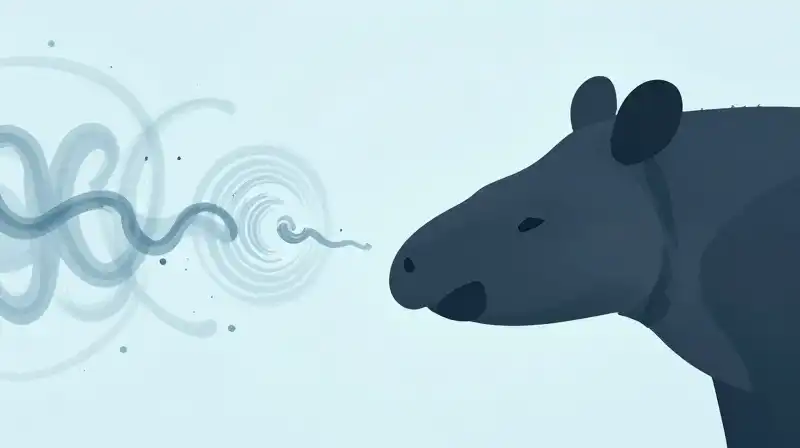
In psychology and biology, we often look at how organisms compensate for a deficiency in one area by over-developing another. The tapir is a prime example of this evolutionary “trade-off.” Because tapirs often have relatively deficient vision, they have developed a suite of alternative sensory tools to navigate their world.
To make up for what they cannot see, tapirs rely on a combination of hearing, smell, and touch. Their ears are highly sensitive, and their sense of smell is incredibly keen. A fascinating behavioral demonstration of this is the flehmen response. When a tapir performs this action, it raises its snout and shows its teeth, a specific posture used to better detect and process chemical scents in the air 1.
The Intelligence Behind the Instrument
It is a common misconception that large, solitary animals are unintelligent. However, the way a tapir uses its snout to manipulate objects is evidence of a higher level of cognitive function. Their resourcefulness is seen in several key areas:
- Problem-Solving: The ability to use a body part to achieve a goal (like reaching food) requires spatial awareness and planning 1.
- Environmental Resourcefulness: Tapirs don’t just wander; they actively seek out or create specific resting spots, such as hollows in the ground or utilizing fallen trees and dense vegetation for cover 1.
- Water Adaptability: They use water sources not just for drinking, but as a strategic tool for cooling down, seeking refuge from predators, and even removing parasites 1.
Frequently Asked Questions
What can a tapir manipulate?
A tapir can manipulate various types of foliage and organic objects using its prehensile snout. This allows them to grasp branches, pull leaves, and navigate through thick brush with high efficiency 1.
How does a tapir hold things?
They do not use hands or paws to hold objects. Instead, they use the soft, flexible tissue of their proboscis to wrap around, grasp, and pull items toward their mouths 1.
Key Takeaways for the Curious Observer
When studying the tapir, it is helpful to move past the surface-level view of a “large, slow animal” and look at the specialized mechanics that allow it to thrive. The tapir’s survival is a masterclass in adaptation:
- Specialization is strength: The prehensile snout compensates for limited vision, turning a sensory weakness into a tactile strength.
- Intelligence is often hidden: Social intelligence, strong memory, and problem-solving skills are present even in largely solitary creatures (2, 3).
- Environmental mastery: Their ability to manipulate their surroundings—whether through water use or creating resting spots—shows an active, rather than passive, engagement with their habitat.
References
Footnotes
Frequently Asked Questions
What can a tapir manipulate?
A tapir can manipulate various types of foliage and organic objects using its prehensile snout. This specialized tool allows them to grasp branches, pull leaves, and navigate through thick brush.
How does a tapir hold things?
A tapir uses the soft, flexible tissue of its prehensile proboscis to wrap around, grasp, and pull items toward its mouth. It does not use hands or paws to hold objects.
Related Articles